Saturday, October 30, 2010

Damaged Again

This option would allow for the players modified attack roll difference (vs target number) to imply mechanically a deadlier blow was delivered.

How it Works
You roll to hit as normal.  If a successful strike was delivered, subtract the target number from the players modified die roll total. This result is then compared to the chart below :

Damage table
  • Difference of 1 to 3 = 2pts damage
  • Difference of 4 to 6 = 4pts damage
  • Difference of 7 to 9 = 6pts damage
  • Difference of 10 or more = 6pts+1d6 damage  
  • If a two handed weapon is used in combat add +2 to the damage done

Damage effects
You may wish to add a bit of flair or impact to combat.  To do so (for roughly man sized opponents)see the options below:

  • IF DAMAGE RESULT IS 4 POINTS roll an additional 1d6.  If the result is an even number there is no additional effect, if the roll is an odd number the target staggers back a distance in feet equal to number on die roll.
  • IF DAMAGE RESULT IS 6 POINTS roll an additional 1d6.  If the result is an even number the target staggers back a distance in feet equal to the number rolled.  If the result is an odd number, the target falls to the ground and must spend their next action standing up.
  • IF DAMAGE RESULT is 6+1d6 use the total sum of damage.  If the result is an even number the target is knocked down and must spend their next action standing up.  If the result is an odd number, the target is knocked down and stunned and may make no action on their next turn.  The next action the target makes is either to stand or flee.

Mechanical Example: The player attacks a target wearing leather armor (AC12) The player rolls a d20 and gets a result of 16. The difference between the target number (12) and the die roll (16) is 4.  Using the damage chart it shows 4 points of damage are applied to the target. Using the optional rules the player would roll another d6 to see if there was knock back.  The player rolls and gets a result of 3, so the target would stagger back 3 feet after taking the damage

Cinematic version: Toshiro Redcap spies an archer guarding a passage way up ahead. Clinging to shadows cast by flickering torchlight he creeps to within striking distance. Edging closer his final step  suddenly sends a sharp squeak into the silence. The nightingale board gives away Toshiro’s movement and the archer spins round on him drawing back his bow. The archer turns too late as Toshiro’s katana slashes down cleaving the gap between them and biting through the archer’s armor.  Blood wells from the cut and the archer staggers back in pain and surprise.

I think mechanically it works and fits with the cinematic combat of earlier editions. Jim at Carjacked Seraphim posted a simple to use chart for this mechanic to use with OD&D and/or other d20 systems.  Kudos Jim! I can't wait to use your chart for my Halloween haunted house game.

Sunday, October 24, 2010

Damage via d6, another option (edit v 1.1)

Recently JB made an excellent post regarding the d6 as the arbiter of weapon damage.  I agree with much of JB's thoughts although I have a twist on it which I am using in my ROGUISH RPG.

I believe there should be at least some sort of subtle difference between daggers, spears, sling stones, battle axes and long swords.  Yet I do not want to use multiple dice types (ROGUISH is d6 only) nor have everyone running around with the same weapon because it does X damage.

So how to make them interesting and different while using d6 only?  I decided to create damage classes.

(L) Light damage = roll 2d6 keep the lowest number rolled
(M) Medium damage = roll 1d6 use number rolled
(V) Heavy damage = roll 1d6 and use highest number
(X) Extra Heavy damage= roll 1d6 and add +2

Weapons, monster attacks, and spells all use this simple short hand notation (L, M, V, or X).  So if you like the idea of d6 weapon damage but want to keep a bit of difference between weapon types, this might work for you.

Saturday, October 16, 2010

The Cleric Conundrum: Van Helsing

At the same time, the cleric class, in its origins and even in its in-game description, isn't a completely good fit for medieval Christian priests. It's a bit more like a religious knight (as opposed to the paladin, which is a "holy knight," if the distinction makes sense), but its essential character is that of Van Helsing from the Hammer horror films -- a monster (i.e. undead) hunter. 
--James Maliszewki  10/11/2008

I dislike the cleric class for much the same reason many in the OSR dislike the thief class.  The argument is the thief class can be considered in game terms a broken and unnecessary class.  By creating a specialized class and skills, a broken subset of rules was made to handle previously common talents and the basic game structure was then broken.   The thief then is an artificial class construct that limits what any character should have a reasonable chance to do: climb walls, find and disarm traps, pick locks, scale walls, hide in shadows, or sneak around.

If one agrees to this then I would ask you to consider if the cleric is any different?

The cleric in essence is a specialized fighter with
1) Spell casting ability
2) Ability to turn undead
3) limited weapon choices based on deity

Spell casting
There really isn't, to my mind, any reason why the spells allocated to the cleric class should not just be part of the wizard's spell lists.  The conceit for game play is that they are divinely granted, but with the wizard class already the core spell caster in game terms, these spells should really just be part of the wizard lists.  If you can agree to that, then one is left with a fighter, on a mission from god, with weapon restrictions from that deity, that can turn the undead.

Turning Undead
In order to turn the undead the cleric must present a holy symbol.  So in game terms, isn't the power over the undead really the result of ownership of a holy symbol or blessed relic?  That being the case couldn't anyone/ or any class use it?  Of course they could, but the cleric gets a bonus to do so and in game terms is the only class that can do it.  This ability, based on presentation of a holy symbol, is something any character could do, just like picking a lock, or sneaking around.  The limit or effectiveness would be based on the power of the holy symbol, perhaps varying ranges of Holy Symbols +1 through +5, or better yet specialized symbols or artifacts that effect specific undead types.  Far more interesting in terms of game play.

Weapon Restrictions
Weapon restrictions based on deity are not something that requires a class distinction so much as it is part of a character concept.  Dwarves are fond of axes and hammers, elves bows, and perhaps due to regional or clan religion there is a ban on ranged weapons, or edged weapons.  It is an interesting concept for a character, but not something that requires a specialized class.

Van Helsing
If you think of the recent Van Helsing film, he was a fighting man in service to the church.  The church supplied him with the tools/weapons and hireling necessary to fight the undead.  He did not cast spells (any more so than did Peter Cushing's Van Helsing) he was simply armed and equipped by the church to battle a specific monster threat.

In effect Van Helsing is just a fighter, on a mission, given tools by his employer to accomplish the mission he is hired to do.  Using the Van Helsing reference, and comparing the Cleric class to the thief class...is the cleric class unnecessary?

Saturday, October 2, 2010

"...and then what happended?"

In most forms of entertainment there is a finite resolution.  Books, Movies, TV series, board games, video games, card games, etc.-they all have in common a definitive end at some point.  Role playing is different though as there is no clear winner and the adventures never need end.  Even if a character dies, a new one can be created and can join right in.

It's the rare entertainment though that leaves one with a "...and then what happened?" ending.  By "...and then what happened?" I mean there is no clear resolution and a sense of leaving to the individual's own mind the possible resolutions.  I don;t know if this is possible in RPG's but I am intrigued at the potential.  I guess a campaign is really an extended "...and then what happened?" Yet I've never refereed or played one that really left me with that feeling. Is it possible?

For example,  did Clint Eastwood survive the swim in Escape from Alcatraz or not?  At the end of the first star wars film (1977) does Vader live? die? become a renegade?  (as an aside I remember long debates in grade school (before Empire Strikes Back) about what happened to Vader and the Empire at the end of Star Wars and frankly I still think our ideas at 8 or 9 were better than Lucas')  My point is that not resolving everything (what was in the case in Pulp Fiction?) and leaving it to individuals to ponder or resolve is a rare event in entertainment.

You probably missed it, but this week was the end of the second "THE COLONY" experiment, and it was an ending that my wife and I are still discussing.  We did not discuss the end of BSG or Lost for more than a day and frankly both of those were completely lame in comparison to how THE COLONY ended.

THE COLONY is a show on the Discovery channel that pre-supposes a global pandemic causes the breakdown of civilization.  Into this setting a group of individuals is put together and for 50 days and tries to survive.  Through the days they must find food, scavenge equipment, defend themselves from hostiles, make moral decisions over helping others and in general just try to survive.  It is an extremely interesting show not only from the "survival" aspect but from the civilization versus self preservation difficulties and moral questions that arise.  For example food and clean a water are limited, and your group of 12 has enough for maybe 3 or 4 days...and then a group of 12 women and children come by begging for food and water outside your shelter: Do you help them? Do you keep it all for your own group? If you do give it away will news of that get around to other people? What happens to you if everyone scavenging in the wild thinks you have food and decides to try and come take it? Will you be able to replenish the stock you give away?

In season 2 the scenario is: After a global pandemic wipes out most people, the uninfected colonist are dropped off in a government safe area by a group known as VOPA.  (VIRAL OUTBREAK PROTECTION AGENCY)..and then kind of abandoned to survive with a bit of food and a few supplies. VOPA appears randomly as do raiders, traders, and other interesting twists.  All the while the colonist try to survive and improve their daily lives.

...and while season 1 and 2 are both good, Season 2 is far and away a better show.  For those who intend on renting or buying the DVD's of the series or finding them online to watch, please stop reading here.  All I will says is the series, and the ending in particular, will keep you off balance and discussing "...and then what happened?"

SPOILER: At the end of Season 2 the Colonist find and raid the enemy camp, make off with some supplies and decide to evacuate to a previously discovered and unoccupied fishing house in a fan boat they constructed.  The destination house is right on the water, has a dock and is undamaged.  Easy food and clean water available and no one else around!

After the raid as they are packing to board the boat VOPA suddenly arrives in 3 or 4 black Suburbans.  One man gets out and says he can take TWO of the group to a safe area where they will have meals and treatment and be protected...who wants to go?  VOPA's previous involvement was about zero so this is a shock to the colonists, and despite all the vehicles the can only take two colonists because the rest are filled with agents...its odd to say the least.  So one woman colonist (and only one) agrees to go.  As the vehicles drive off, you hear the sound of aerosol spray cans  and the woman screaming while the vehicles leave the encampment. 

Cut to the Colonists camp suddenly being counter attacked by raiders.  The colonist hurriedly get onto their boat and take off.  Then you get the normal fly over scenes of their ragged boat cutting through the water in the sunlight. Now comes the camera face time for each colonist about "what they learned" and then a pan shot of the boat and colonists faces as they approach their safe house.  You see smiles and the Colonist faces as they see the house..and then suddenly smiles change to fear and disbelief...one or two guys pick up their makeshift weapons, and the camera pans 180 to the house again...a group of armed raiders comes charging out of the house and on to the dock threatening the colonists...then the screen goes black....and then what happened??


It's rare when you are left hanging and get so many plot twists at the very end of a TV season that will never be resolved.  There is something about the inherent gritty nature, moral quandaries and surprise plot twits in this series, and in most PA material (not of the radiated mutant variety) that is intriguing.  If you enjoy it as well, The Colony is good show for you to explore.

Thursday, September 23, 2010

Pokémon + James E Raggi = ?

POKEMON FUSION

I am not quite sure why Mr. Raggi's work came to mind after monkeying about with this neat little site.  Perhaps the strange yet interesting results from cross pollinating the cute and the creepy and seeing their off spring become Lovecraftian nightmares of strange proportions simply fit?  Anyway its an instant creature generator for your next campaign!

I have 4 copies of the completed COLLAPSE RPG in my hands and will begin editing.  In addition another kind soul offered to do some editing as well so once that is completed, it will be up on LULU for purchase.  probably end up around 100 pages and I am thinking it will be around $12-$15.

Work has been absolutely mad recently and the first limited public test of a brand new retail concept has been central to swamping my schedule.  Hopefully things will become a bit less crazy and I can finish COLLAPSE editing for publishing, and then focus on getting ROGUISH completed once and for all.

Cheers for now!

Sunday, September 5, 2010

COLLAPSE RPG: Player's Manual now a free download

As the game is undergoing some final editing and a print test, I have decided to make the Player's Manual a permanently free download. This will give you a sample of the game system and if you like it, you can purchase the complete game manual in the near future.

Your feedback is appreciated.

Want to make God laugh?

Tell him your plans!

So I sat down to finish the Roguish player book, and my lovely wife started talking about The Walking Dead.  She has caught up with me by finishing collection 12 and we spent awhile discussing the series.  Then we had a beer or two and talked about the way Kirkman set up the world the characters inhabit.

Afterward, the furthest thing from my mind were swords, elves, and dragons.  Instead I kicked my arse into over drive and completed my COLLAPSE RPG.  In fact it is so complete I have copies on order for editing from LULU to review prior to making it a live purchase. It's an 8.5x5.5 little beauty or at least, I hope it turns out that way!

Holy crow it's nearly done.  Given the general COLLAPSE, outdoor survival, prepper, financial crisis, zombie loving vibe that is currently in vogue here in America, I have hopes that a simple pick up and play 92 page complete RPG will find some interest.

Below is a sample NPC for the COLLAPSE RPG:


Name
ST
IQ
DX
EN
MV
Wn
Dmg
Wep
Rick Brandt
-1
0
0
0
4
6
2w
 Pistol
Age: 25
Careers: Air Force +1
Race: white
Traits: Forgiving, reliable, indecisive, uncooperative
Econ: low middle class
Rick grew up in a small town in the middle of nowhere.  Ever since he was a little kid, all Rick wanted to do was to be a pilot.  He dreamed of it and nothing else.  When he graduated he joined the Air Force, but his eye sight and weak physique left ill suited to be a pilot.  Instead he became a mechanic.  When the collapse occurred he tried to fly a helicopter off the base but did not even manage to start it, chased of by base police he passes himself off as a downed pilot looking for a plane.  He claims great airplane knowledge which is true, and flight mechanics knowledge, also true, but he could not pilot a video game jet let alone the real thing.

Rick Brandt Adventure Hook: Rick knows how to get on to the local Airbase, and could possibly get the Players on base.  There is no telling if it is still guarded or not.  Rick knows how to access weapon, vehicle, and tool shops, but is afraid to return and be shown a fraud (not really a pilot) or be put in the brig if the base is still manned.

Thursday, September 2, 2010

Roguish RPG update

I continue to flip between working on my Collapse RPG and my Roguish fantasy RPG. I have taken time with Roguish to rework it and decided to use contested rolls for nearly everything.  In the end it may be everything including spell casting.

The more I play test the contested rolls the more I am sure of it. Blame a steady diet of RISK (the board game) as young lad growing up if you like, but the contested roll feels more organic and interactive than chart consultation by level or strict target numbers. More random? Yes and no. By using 3d6 you have a good bell curve which creates a solid baseline model of expectation of result versus a d20 roll.

The three character classes : Warrior, Wizard, and Rogue will each have class limited class abilities. This allows a character to add a bonus of 1/2 their current level in any attempt to do a few limited tasks. For example a wizard applies his bonus to spell casting, a warrior to attacks, and a Rogue to pick locks. Each race will also have an ability bonus or two so your average character has a total of six abilities with a bonus which makes them a bit unique. The simple add 1/2 your level as a bonus to attempting certain tasks  is easy to remember and apply with out using charts or elaborate formulas.  it also allows any character to try something, they simply do not get the class/experience bonus.

I hope to have the character generation and combat book aptly entitled SWORD & SHIELD done this weekend and the Magic book STAFF and SPELL possibly completed as well. Taking a page from Metagames Melee & Wizard each will be short and easy to digest.  A third book focused on the referee generating adventures, traps, treasures, random tables galore etc. will follow along.

Overall I think the simplicity, interactivity, and brevity of the the books comprising Roguish FRPG will hopefully make it interesting enough to be found on other table tops beyond my own.

Saturday, August 28, 2010

The Dead are Walking

I've talked about it a few times before (how great the Walking Dead comic series is by Robert Kirkman)...now you can see it!  Well you will soon, for on Halloween the series begins on AMC.  See what you have been missing with a sneak peek below. As an avid fan of the comics, I am pleased to say it is a near perfect translation and seems to add even more depth to the characters.

Monday, August 23, 2010

Collapse Player Manual

The player manual has been removed for now. There are further updates to make such as a character creation example, a few game play examples, and a family member generation chart. If you have specific comments please post below.

Work progresses on the Administrator's manual as well which will have NPC's, animal stats and alien/zombie stat charts, Collapse scenario ideas, movie and book lists as well as other tidbits for an administrator.

I have time over labor day to work on this so I hope to have the revised player manual and Administrator manual ready shortly after.

Additionally should they be two separate manuals or one combined book?I feel 2 separate books allows players to access what they need while keeping the administrator stuff out of prying eyes, but your opinion and feed back is appreciated.

Saturday, July 24, 2010

Fear of the Dark

One of the oldest fears of man is of the dark.  What lies out there in the darkness beyond the fire's light? It's a primeval fear that remains with us regardless of time period or technological advances.  In fact depending upon the historical era, what man feared in the darkness  seems to have changed. Whether from wolves or witches, bears or bandits, the darkness has birthed many a monstrosity both real and imagined.

Man's battle against the dark is a never ending one.  From protecting one's kith and kin against what may come in the night, to creating method's of pushing back the darkness by creating new ways of making light.  We still today bar doors and windows despite our homes, streets and cities being flooded with light...yet the darkness still clings to the corners and edges, never truly defeated-only at bay.

There is a brilliant "history of darkness" entitled At Day's Close by A. Roger Ekrich which looks at man's historical relationship with the dark: what did man do when his available light was limited and how did he live with the dark in ages past? What were his fears, real and imagined, and how did he combat and defend against them?  It is a fascinating journey into our relationship with the darkness.  When light is only a finger flick away, why do we still fear the dark?  And if there is nothing to fear from the dark, why do we try so desperately to light every corner of our homes, streets and cities?

I will be the first to admit, as a product of a technologically advanced society, I never truly used the darkness properly when gaming.  When  every switch or knob in the modern home is in effect a "light spell" how can I effectively portray ancient tombs, dusty dungeons, and overgrown graveyards? In gaming terms, it was simply dark-then someone cast a light spell, fired a torch, or lit a lantern and that was that.  I have a new found respect for what darkness means in an age when fire for light and warmth could as easily mean burning down your house or city. Where a farm or house with lights on stood out as a beacon and invitation those who rely on the darkness to prey on others.  Where the night watchman was as likely to be a participant or look out for crimes in the dark as he was to be a protector or at least early warning system.  

What use is archery in the dark? None! You have to close upon your enemy and meet them at a sword's length.  When you are weaker than your opponent (goblins? kobolds?), darkness serves to at least even the odds if not give you the advantage.  A light in the darkness tells me where you are, but further blinds you to where I am.

I think too often I have failed to properly handle light and darkness in a dungeons depth.  You have to see to fight...and if your opponent does not need to use a light to see...then those that do are at a complete disadvantage.  The party will be ambushed, and their light provides a target for an archer to fire at. If that light is lost...they become lost as well.  We see this today as night vision armed military units are able to decimate at little loss to themselves an opponent who must rely on light to see.  I never liked the trope of playing by candlelight, but am considering doing so if only to illustrate what darkness and light mean.

How do you approach darkness in your games and settings? Are your players afraid of the dark?

...they should be...

Sunday, July 4, 2010

Celebrate Indpepndence!

1 : not dependent: as a (1) : not subject to control by others : self-governing (2) : not affiliated with a larger controlling unit b (1) : not requiring or relying on something else : not contingent (2) : not looking to others for one's opinions or for guidance in conduct (3) : not bound by or committed to a political party c (1) : not requiring or relying on others (as for care or livelihood) parents> (2) : being enough to free one from the necessity of working for a living d : showing a desire for freedom

Saturday, July 3, 2010

Inspirations

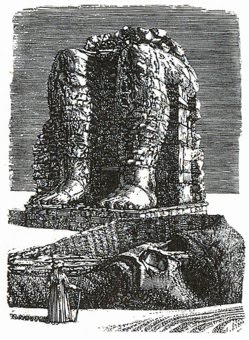
One of my favorite poems is Ozymandias.  Not just the more well known Shelley version, but I'd say even more so the competing version by Horace Smith.  Both are below as inspiration and you can decide which version speaks to you more.

As a historian the rise, fall, and rise again of man over and over throughout history is intriguing.  Most notable is that at man's zenith in any particular civilization, he becomes arrogant and assumes his sliver of time on the top in a given age is the pinnacle of human existence and that it shall never end.  History shows time and again that is not the case, as a collapse inevitably comes, and man must find his way again through the wilderness.

In both versions of Ozymandias each poet deals with this arrogance of man and civilization in a different tone, yet both are evocative and powerful for different reasons.  It's the individual poets focus that creates a different sense and emotion for the reader.

So how does this apply to gaming?  Consider the lowly dungeon.  Though not always the case, in general it is a ruin from a past time being explored.  The Referee should consider if those who came before were at the height of their civilization?  In an ascendancy cut short?  Were the builders the result of a race in hiding or survival mode during their decline?  When you decide at what point the builders constructed their dungeon, then that will influence what is found by the new age explorers as well as color how you present the dungeon and how the builders present themselves to the players exploring.  Without further rambling-the poems:

In Egypt's sandy silence, all alone,
    Stands a gigantic Leg, which far off throws
    The only shadow that the Desart knows: --
"I am great OZYMANDIAS," saith the stone,
    "The King of Kings; this mighty City shows
"The wonders of my hand." -- The City's gone, --
    Nought but the Leg remaining to disclose
The site of this forgotten Babylon. We wonder, -- and some Hunter may express
Wonder like ours, when thro' the wilderness
    Where London stood, holding the Wolf in chace,
He meets some fragments huge, and stops to guess
    What powerful but unrecorded race
    Once dwelt in that annihilated place.
--Horace Smith 1818

I met a traveller from an antique land
Who said: Two vast and trunkless legs of stone
Stand in the desert. Near them, on the sand,
Half sunk, a shattered visage lies, whose frown
And wrinkled lip, and sneer of cold command
Tell that its sculptor well those passions read
Which yet survive, stamped on these lifeless things,
The hand that mocked them and the heart that fed.
And on the pedestal these words appear:
"My name is Ozymandias, king of kings:
Look on my works, ye Mighty, and despair!"
Nothing beside remains. Round the decay
Of that colossal wreck, boundless and bare
The lone and level sands stretch far away.

--Percy Bysshe Shelley 1818

Additional Note:
There was a solo adventure The Security Station from Metagaming for TFT that dealt with this idea quite well.  Sort of an S3 for the Fantasy Trip...

Monday, June 28, 2010

Monday Maiden

IRON MAIDEN that is!  New feature, every Monday I am tossing up a favorite Maiden tune because damn those guys still rock! UP THE IRONS!